Showing posts with label book review. Show all posts

Friday, August 22, 2014

Don't Forget Me, Bro by John Michael Cummings

The last words Steve Barr ever said to his brother Mark were, “Don’t forget me, bro.” When Steve passes away (perhaps from complications from his schizophrenia or a complex reaction to his prescribed drug cocktail) Mark insists on driving back to West Virginia to visit his spiky, damaged, unloving family and try to fulfill Steve’s last request.

What follows in the novel, titled after Steve's last wish (due out this October) is a journey into the heart of starkness, an odyssey of within and without. Leaving Brooklyn and returning to his family’s broken home – in every sense of the word – makes Mark confront memories that are unbelievably bad and, along the way, golden as well.

John Michael Cummings details this journey without a trace of Lifetime-movie proselytizing or Hallmark card sweetness. Each character is real, alive, vibrant in their sodden acceptance of the ugly nature of living and being human. Only Sherry Mayer, the mentally-challenged girl Steve called his girlfriend, sees life as colorful and wonderful, a view reflected in her pink, sparkly sweatshirts and the way she eats fries - by throwing them in the air and catching them in her mouth.

The lovely language of Mark’s journey, both inner and physical, seduced me completely. It’s tough and spare, but beautiful at the same time. Look at this description of Steve, the deceased brother:

Steve was that guy on “COPS”—no teeth, no shoes, no shirt, hairy white beer belly hanging down over his dirty jeans, screaming and hollering in the street for Momma or Loretta Lou, only to whimper as the cops walked him like a child to the backdoor of the squad car.  On that last visit home eleven years ago, I had thought—he’s dead already.
Greg, Mark’s second brother, is evoked through an odd little story:

God, he was still strange.  Back in junior high, he once ate a whole lemon—bit right into the bright-yellow rind, then proceeded to chew it up and swallow it down in half a dozen face-wrenching bites, just to impress some girl who, as it turned out, wasn’t even watching.  Instead, he impressed half the guys in school.  They looked at him, at first amazed, then a little weirded out. 

And there are tiny details that catch the readers by our throats, pulling us further into this peeling, gothic world: a Snoopy figurine, with ‘angry, inverted-apostrophe eyes’. I was transfixed by the simple horror of ‘Overhead sagging power lines, black snakes frying on the sky.’ In fact, snakes appear throughout the book, most frighteningly as a metaphor for the wires Steve and Mark’s father attached to Steve’s mattress designed as homespun electro-therapy for when the boy wet the bed.

Yes, Cummings isn’t holding back in this book. Such dark visions take great courage to write, and I was lulled and horrified by those dreams.

Throughout the novel there is a struggle over burial versus cremation. Mark is entirely against turning his brother to ashes, since Steve requested a corner of the churchyard near their grandfather. This theme is expounded, always with frustrated attempts: the burial ground has a two-year waiting list. Mark cannot get legal advice quickly enough. And always his own stifled endeavors, lost promise, and mental challenges are there to catch him up, stop him from doing something heroic.

As someone who cremated both parents, I was able to read with detachment the sections giving Mark’s fervent opposition to cremation. After all, he is what is now called an unreliable narrator, and we all have different views on death and the afterlife. Still, for those readers who might not be able to read those sections with such detachment, I must advise caution for those chapters.

I loved the scenes with Sherry, and even the taut, frigid interactions with Mark’s parents are so real they bloom like funereal flowers. However, my favorite section of the book was the painting of Steve’s old bedroom with Sears paint Mark finds in the attic. The walls are covered with notes about the Baltimore Orioles, and Mark refuses to use primer or sandpaper before he splashes on the Eggshell White. His method is explained, and for me it crystallized the novel:

There was a secret reason for my slap-dash approach. If I painted over the Mona Lisa, experts could remove my cheap Sears paint, and there’d she be, unblemished and all the more radiant for the world to worship. If I soaked Steve’s walls without first sanding away scuffs, smudges, and stains, the evidence of his growing up in this little house might not be destroyed but preserved.

Not destroyed, but preserved.

Because it seems we are all looking for a piece of the future, a slice of memory even after we are dust or ashes. As we write, create, paint, or simply survive, one large portion of being human is a plea that screams, Remember this. Don’t forget me. Don’t forget me, bro.


You can find John at Goodreads and Amazon Author Central. 

Thursday, March 13, 2014

Review of 'The Pre-Raphaelite Seamstress'


Part romance, part cozy mystery, The Pre-Raphaelite Seamstress by Amita Murray was a thoroughly enjoyable read. The author has done a great deal of research for the book, and this showed in a number of colorful details as well as rich settings and backgrounds, glowing with life.

Rachel Faraday is forced to make her own living by painting fabrics; her influences are Dante Gabriel Rossetti (and yes, the painter does appear in the novel a lot, and he is wonderful.) She tangles at the start with Harry Twyfold, brother to one of her customers, and an instant will-they-or-won’t-they attraction is set up.

However, Twyfold is arrested under suspicion of murder, and Rachel spends the rest of the novel trying to solve it before Harry is hanged as a killer. This makes for a bit of a problem for the romance, since the scenes between the two are in prison and few in number. Murray makes them count, however, with just the right amount of anger and tension.

Furthermore, the painter Rossetti meets Rachel and takes her as a student. They develop a relationship of their own, an original combination of teacher/student and seducer/seduced. It was in those scenes Rachel flowered as a character; she is forthright, upfront, and bold. The painter himself is perfect, with a combination of self-assured sensuality and genius, versus a fleshy air that repels and attracts the artistic Miss Faraday.

When she’s not studying with Rossetti, Rachel is on the case with Gil, her cousin, and later some new characters she didn’t know were alive at all. (Spoiler alert – I’ll add this at the bottom under the stars, so don’t read the final paragraph if you don’t want to spoil the surprise.) Gil spars perfectly with Rachel, and the scenes in her kitchen with her companion, Magda, are really funny.
 
Image Courtesy of The Telegraph
There were a few chapters that were info dumps, serving up indigestible chunks of backstory in long paragraphs, but they were necessary to the story and not mere filler. Anyone who has read and enjoyed Pride and Prejudice or any Georgette Heyer novel won’t have a problem with those.

As Heyer herself has done, Murray carefully adds real background, and in a delightful way. One of my favorites was Rachel moving through a marketplace, speaking to the owners of the stalls:

I dodged chickens, stilt-walkers, girls dancing the hornpipe egged on by a crowd of engorged men, a Happy Family hand barrow, and shoeblacks sitting in the middle of it all, oblivious to the threat of getting crushed in the melee. The crowd forced me to slow down, and vendors stood in my way, showing off their wares and haggling, and I kept saying, “Sorry, sorry! This way, please. Sorry, right behind you! I do apologize. I don’t need a laudanum tincture or battered halibut! Just, please let me pass!” (2014). The Pre-Raphaelite Seamstress (Kindle Locations 1063-1067). Amita Murray. Kindle Edition.

There were a few notes that didn’t quite ring true: Gil apologizing to a stall keeper – a woman at that. Since he is higher in society, I can’t imagine that happening in the nineteenth century. Furthermore, the comfortable conversations between Rachel, Gil, and Magda would never happen in that rigidly structured society. However, I can see those conversations add to the plot, so if you’re willing to overlook some faults of accuracy, you will really enjoy the book.

Another example is Rachel’s “sunflower yellow” teapot. I’ve had tea poured from many a pot in England, and I’ve never seen a yellow one. So I did some extensive research of my own to look at typical pots of the period, and they were mainly brown, like my own Brown Betty pot. Also, a character invites Rachel to look through her own bedroom upstairs – something I just can’t imagine happening today, let alone in Victorian England.

But look at me, niggling over details… in doing so I’m definitely missing the forest for the trees. Just taste the way the author describes the area of London near Rossetti’s studio:

The lights mingled with the chimes of St. Paul’s, and the calls of the barges near London Bridge, scuttling coal and bricks, sand and timber. The grime, the soot, the pickpockets, the stench, the prostitutes with peeling skin and a dry pain between their legs – these didn’t disappear in this new London, but merged into it. I would watch a mudlark trawling through the rubbish down in the street, picking out lost pieces of coal from between the rats, the broken china, the refuse, and even that seemed like a natural part of the life that made up the city. I would watch an urchin scavenging for a piece of bread. A cat staring at me with its green-amber eyes before disappearing into the fog. It was magical. It was real. For those hours that I spent in Rossetti’s studio, I could reconcile to living in London and not have the constant feeling of wanting to be elsewhere. (2014). The Pre-Raphaelite Seamstress (Kindle Locations 1280-1286). Amita Murray. Kindle Edition.

…With writing like that, I can afford to ignore the yellow teapot and the ersatz boudoir visits.

In the end, there are a few chapters that felt ‘off’ to me. One was with the spoiler I mentioned before: it is so dramatic it falls into maudlin category. Overall, however, I was captivated by the book and thoroughly enjoyed it. I give it a solid four stars and recommend it as a lovely novel for those who love the era, the art, and original romance.

*****

SPOILER - Highlight this bit if you want read it: The novel became somewhat banal when Rachel’s mother entered the scene. Her appearance was so extraordinary and led to events which simply didn’t flow for me. I see she introduced some key plot elements, but I wish the author could have found a more natural way of doing it.


Thursday, February 27, 2014

Cinder by Marissa Meyers - Review

I finished Cinder last night with a bit of regret. The first thing you should know is it's the start of The Lunar Series, and it ends on a cliffhanger, so be prepared to find Scarlet (the second book) straight away. Don't languish, as I have done for the past twelve hours, wondering what happened to Cinder until I got the second book.

Yes, this is another retelling of a fairytale, but it's clever and scifi, with cyborgs and gritty future urban fantasy (let's just pretend, for the sake of this review, that is a thing.) In fact, Cinder herself is a cyborg and a mechanic...

Stop right there. A Cinderella story about a cyborg-mechanic? Say no more. I'm in. 

The book begins in the middle of a marketplace. A terrible plague, Letumosis, is ravaging future Beijing, and Cinder watches as two people are struck down in front of her. Enter Prince Kai, the future emperor, with a job for a mechanic. Cinder is the one he chooses.

I'm going to stop here and say Prince Kai is awesome. He's natural, brave, and dedicated to his father and his job. He's confused, too; he doesn't see why Cinder won't accept his invitations or talk to him. For her part, she is strong and smart - and she has to hide her attraction to the prince since he doesn't actually realize she's a cyborg.

There's a beautiful antagonist in the shape of the lovely Lunar Queen, Levana. I'm a sucker for a gorgeous villainess, so I'm all about her and her glamour. Naturally she wants to suck Kai into her evil trap, so her character sets up a great deal of exciting tension.

Meanwhile, Cinder has problems of her own. Her wicked stepmother wants her to earn money for her daughters (and in a nice twist, one of the stepsisters is actually nice.) She only has a robot, Iko, to turn to for help. Plus she has to get that job done for the Prince without her stepmother finding out.
Image courtesy of Flickr

Yes, there is a ball. Yes there is dancing. Yes, there is a flight of stairs and something falling off - but not a shoe. None of it is boring, however, in a Yet Another Sunday Night TV Show About Fairytales way. Meyers has created real characters and a compelling world as their showcase.

I have to repeat the warning this is the first book in a series. The writer leaves the ending very open, but luckily I waited to read it and have my mitts on that second book now, so Ha.

My rating for Cinder is a solid four stars, with a half added on for the car Cinder turns into her magic coach.

Wednesday, February 26, 2014

The Long Secret

I see Delacorte is reissuing Louise Fitzhugh's books to celebrate the 50th anniversary of Harriet the Spy. Now, while I loved Harriet, it was Beth Ellen who really stole my heart in the relatively unknown book The Long Secret.
Beth Ellen, courtesy of Flickr

Beth Ellen appears in Harriet the Spy as a shy, pretty girl with no personality. She's a real "Mary Sue" in that book until the end when she plays a pivotal role during a class election.

But in The Long Secret, Beth Ellen is the main character, and Fitzhugh peeled back the layers of her upscale, privileged life to reveal subtle anger and damaged childhood - all while telling a mystery. Who is leaving anonymous notes all over Water Mill, Long Island?

Harriet is still there, brash and brave as ever. She and Beth Ellen are best friends for the summer, since their families both have houses there, and over the course of the season they meet the Preacher, the Jenkins Family, and Beth Ellen's real mother, Zeeney.

Because Zeeney has arrived with her new husband, Wallace, who converses only with one word - Hup! This forces Beth Ellen to reexamine her life with her grandmother, her friendship with Harriet, and confront the enormities of growing up. The scene when she gets her period for the first time is so, so, so much better than Are You There, God? It's Me, Margaret. (Sorry, Judy Bloom fans.)
The very issue I had, courtesy of jezebel.com

Furthermore, this book made me laugh out loud, which was embarrassing in a quiet reading classroom. I defy anyone to go through the chapter set in the country club as Harriet spies on Zeeney and Beth Ellen without a chuckle. However, the scene is quietly sad, as well, as Beth Ellen limply puts up with everything her mother does - until Harriet's own wonderful mother steps in.

And the setting truly came to life for me. If you've read my blog before you'll know I love maps, and The Long Secret comes through with a fantastic map of Water Mill. I can just picture the gas station where the girls go to fill their bike tires with air before they buy cookies and head to the beach.

I've only scratched the surface here. You can still find images like Mother Jenkins wearing the same black dress as clothing and bathing suit, making toe medicine from watermelons, and - of course - tomato sandwiches. Janey's visit is superb. So is the Preacher himself. They are all detailed with the usual brilliantly scratchy illustrations.

But shining bright throughout the book is Beth Ellen (Mouse) herself, finding a voice during one Long summer.

Do yourself a favor and find this book.

Tuesday, February 25, 2014

The Book Thief and Tortilla Soup

It was a weeknight in January. Sloppy, bone-chilling, icy rain poured over my car as I dropped off my daughter and headed out to the stores to run some errands.

Those done, I realized I was starving, there was no time to drive home for food, and I didn't fancy sitting in a restaurant by myself looking at the walls as I ate slop. A book would solve the problem - I dashed into Barnes and Noble and grabbed the first interesting book I saw.

It was The Book Thief.

With my new book in my hot little hands, I drove to Chick Fil A and order a bowl of their chicken tortilla soup. Icy drops beat against the windows as I began to read and eat my soup, which was delicious, but more on that below.

Just last night, a month later, I finished The Book Thief. I read it slowly, wanting to taste each sentence the way I savored that soup: indulge in the spice, the warmth, and the sadness of the story. However, Thief is not all angst and terror - I've written a post on the greatest books I'll never read again because they are so sad, and Thief doesn't fit that category. 

Because it shines with humanity and the tiny joys people find even in the worst circumstances. The concepts took my breath away, especially the idea of painting over the pages of Mein Kampf and rewriting the book with the thoughts of a Jewish refugee hiding in a cellar. Those pages are reproduced in the book, and you see the words of Mein Kampf trying to bleed through - painted over with new creation, never to be forgotten.

But I'm getting away from the real point of the story. Liesel, the main character, is so real and human I'm afraid to watch the film now. She's become a living persona - tough, athletic, determined to learn to read from the books she steals. Max, the Jewish refugee in the cellar is alive too. So is Papa, Liesel's adoptive father, with his cigarettes and accordion - he is real too, as is his wife - that 'wardobe' of a woman.

And Rudy, her neighbor and friend, who spends their years together trying to get a kiss. Their story is tender and breathless - but real, too. Rudy and Liesel are real German kids, trying to process what the hell is going on around them as the world descends into chaos - not in a poetic, lyrical way, but in a tough kid, bloody your nose, 'I'm going to call myself Jesse Owens' kind of way. 

I really loved them.

The book is set in a German village, told from the point of view of Death. It's another amazing concept and perfectly detailed. Death must collect the souls as bombs are dropped, people starve in concentration camps, and soldiers are blown up. It's the perfect voice for the story - calm, passionless, but quite as tender as Liesel and Rudy's friendship.

Did I mention the writing is incredible and a constant surprise? Because it is. Zusak is a true wordsmith.

When I reached the end of the book last night, I knew I'd read Thief again. It's too glorious not to - unlike the other amazing, heart-chilling books in my post (I'm looking at you, The Road) there is a constant warmth which made me hope for... I'm not quite sure. That people would read this and just think about it? That Liesel would finally allow Rudy to have that kiss?

It went perfectly with the icy hands on the windows, but The Book Thief would be wonderful in the sun as well, when spring finally does relent.


Now for the soup. 

The chicken tortilla soup at Chick Fil A is amazing - spicy, warm, and as I ate it with some of those little crunchy tortilla strips on top, I thought Death had collected me instead of Leisel's brother. In fact, it was so good I had to make it myself. More snow was about to roll into New Jersey, so I made a double batch and froze half.
Image courtesy of Flickr; labeled for noncommercial reuse

Yeah, that's NOT the way to go. The beans in the second half redoubled their fury during the freeze, to the point my husband cried for mercy, even after using Beano. We renamed it and it became part of our venacular: "Hey, hon, want some more Fart Soup?"

But the first go-round was fine, and Beano did the trick of making us less musical. 

I combined several recipes to create the soup; one was from The Pioneer Woman and one from the Less Than Perfect Life of Bliss blog. Here is the result:


"Tastes Like Chick-Fil-a's" Chicken Tortilla Soup

Olive oil
1 medium onion, diced
4-oz can diced green chilies
1 taco seasoning packet (use hot or mild depending on your preference, or create your own)
(4) 14 oz cans chicken broth
(1) 15 oz can black beans
(3) 15 oz cans navy beans
(1) 15 oz can corn
4-5 chicken breasts
1 cup heavy cream (I used half and half and it was fine.)
corn tortillas, sliced into thin strips
BEANO - trust me on this.

***
Preheat oven to 375. Place chicken on heavy pyrex and drizzle with olive oil; sprinkle with taco mix (You can make your own from AllRecipes.com or The Pioneer Woman and make it as spicy as you like.) Turn chicken over and repeat; bake 20 - 25 minutes or until chicken is done. 

(I made extra and turned it into chicken salad the next day - this whole section is from The Pioneer Woman.)

Allow chicken to cool slightly and shred.

Heat the olive oil in a large pot, add the onions, and cook until translucent.  Next, add the green chilies, more taco seasoning to taste, all the canned items, and the chicken.  Bring to a boil, then allow to simmer for several minutes until heated through.  Lastly, add the cream and heat for 5-10 more minutes.  

While it's cooking, create the tortilla strip crunchies for the top: Slice them up (I used kitchen scissors and cut up those babies.) Heat a little olive oil in a frying pan - a castiron pan is perfect. Stir in the strips and allow to brown on both sides - keep shaking the pan and turning them over.

When they are brown, remove onto paper towels. Anthony on Spaghettisauceandmeatballs.com suggests putting a few towels on a paper grocery bag to drain fat from fried or sauteed foods, and it works perfectly. 

Once the soup is done, top it with sour cream, grated cheese, avocado, and those tortilla strips, or any combination thereof. I'm a purist - I just want my strips and naught else.

But do NOT, whatever you do, freeze the leftovers or you will regret it.


Tuesday, July 9, 2013

The Fault in Our Stars

Amsterdam, champagne, poetry, stars - and cancer... 

The Fault in Our Stars grabbed me from the first meeting of the Cancer Kids Support Group, where Hazel is forced to go and interact with other teens who are in varying stages of cancer. Hazel herself breathes with the aid of an oxygen tank, thanks to stage 4 Thyroid cancer. And then there's Augustus Waters - gorgeous, former basketball star, who has one leg but is in remission from osteosarcoma. 


Hazel and Augustus sparkle like stars together immediately. He introduces her to the Max Mayhem series; she shows him her favorite book, An Imperial Affliction. He calls her beautiful. She finds him also beautiful - terrifyingly so. How can she have a relationship if she is terminal? It's bad enough knowing she will break her parents' hearts one day, let alone a boyfriend's. 

However, Augustus is the kind of guy who loves protecting people (maybe because he has so many younger brothers and sisters?) When he plays video games, he loses because he has to rescue the characters. 

I'll interrupt myself here to point out the title comes from my favorite quote from Julius Caesar, when Cassius talks Brutus into murdering Caesar Augustus (Augustus - get it?) :


Why, man, he doth bestride the narrow world
Like a Colossus, and we petty men
Walk under his huge legs and peep about
To find ourselves dishonorable graves.
Men at some time are masters of their fates.
The fault, dear Brutus, is not in our stars
But in ourselves, that we are underlings.

The action moves from Indiana to Amsterdam. Green does a nice job of describing the city through Hazel and Augustus's eyes. They go to a lovely restaurant, Van Houten's house (he's the guy who wrote An Imperial Affliction) and the Anne Frank museum. Oh, and 

SPOILER ALERT 
... Augustus's hotel room - complete with tubes, oxygen, and a Venn diagram.
(select the white text in the line above to read it.)
Amsterdam, courtesy of wikipedia.org

The Fault in Our Stars sucked me right in, but like Hazel's lungs, the book is not perfect. Hazel and Augustus just don't act like teens - she quotes T. S. Eliot, he speaks philosophical wisdom so profound it's difficult to believe it's coming from a human mouth, let alone from a teen dude who was a basketball player. 

I've read a lot of reviews saying the same thing - and yet, here's the deal. Green somehow performed magic and made me care about Hazel and Gus so deeply that I finished the book in  a few days and immediately read it again. It's hard to create that sort of emotional bond between reader and character, so kudos to him for performing it.

The descriptions of cancer are very intense. Green doesn't hold back - no soft, fuzzy "Love Story" haze over the hospital rooms here. No, he details body fluids and puke, as well as heartache. 

It is then Augustus finds there is someone he simply cannot save.

I heartily recommend Fault if you are willing to suspend your disbelief and accept dialogue along the lines of The Breakfast Club - extremely smart and philosophical, but not quite  real : more stage-y than teenage-y. Certainly, the car-egging scene makes up for it, as well as the minor characters: Isaac, Hazel's parents, and Van Houten himself.

I love this tumblr image for the book, found here

This review was a difficult one to write, I found; it would have been easy to trash the characters as idealized versions of kids going through something that really, really sucks. However, there are several things which didn't allow me to do that:

1. My fifteen year old niece loved the book and identified with Hazel and Augustus. Creating that sort of emotional attachment with ink and paper is a very tricky thing and quite an accomplishment. 

2. Green doesn't hold back on teenage anger. I loved that.

3. Did I mention I read this book twice? Flawed as it is, for me this was a portal to a new universe - one with faulty stars, but stars nonetheless.


Thursday, May 2, 2013

I Love David Wong

Why do I love him? If you're a bit odd like me, you'll realize why after about a page of reading his stuff. He writes horror that is incredibly chilling as well as very funny, and  I was introduced to his stuff by Dwight Okita. Dwight never steers me wrong, so I looked at the sample of John Dies at the End.

As soon as I got to the part of the basement door handle and what it turned into, and what David (he's not just the writer, he's also the main character) says as a result, I clicked the Buy button. It was simply a crime not to get the book.

Make no mistake, the horror is very intense. Wong doesn't hold back on the gore and weird stuff that happens in his depressed, middle America town which he calls (Undisclosed.) However, I thought the most frightening part of the book was an online conversation between David's friend, Amy, and some other women. The concept was enough to keep me awake - and made me laugh as well.

Amy is a unique character. Like David, she is damaged, but she has her own strength and poise that transcends her need to take pain meds and a ghost hand. Her missing limb, in fact, is very important in the book. The relationship between her and David, as well as their dog, Molly (who might just be the best dog ever) is very real.

In fact, everything seems so real that I accepted without question an alien sentient drug called Soy Sauce, one that can bend time/space and give superpowers to the user. I accepted that there was a guy called John, a loud, boastful slacker given to much partying - which basically means he'll drink or inject any substance he's given.

Beyond those little weak points, John is loyal, brave, and at the end of the day, a great friend. However, his willingness to try Soy Sauce sucks him, David, and Amy into a series of adventures that grow more and more strange, taking them to Las Vegas, an abandoned mall, and an alternative universe.

John Dies at the End was so good that I saved up to buy the next installment, This Book is Full of Spiders (Seriously, Dude, Don't Touch It.) Yeah, that's really what the book is called. The Kindle copy cost lots of dollars, too. Not so happy about that.

Spiders is just as interesting and horrifically funny as JDATE, but the storytelling falls apart in the middle. JDATE was all told from David's point of view; in Spiders, the author cheats and switches narrators and voice several times. I could understand if it was really necessary to do that, but as I'm reading, I can see how it could have been avoided, to make it a much tighter book, and believe me, I'm not a wonderful editor. 

Still, there is loads of action, plus zombies, Red Shirts, and, yes, spiders. And - how do I put this delicately? - let's just say that the O in Wong could be easily changed to an A. Yeah, there are lots of those flopping around.
Did I mention they made JDATE into a movie?  With Paul Giamatti in it?

Be aware that the books are NOT for children or anyone under 18 - and I might make that 21, actually. They aren't for the squeamish either. But if you would like to see what a book written by Stephen King's younger brother would be like, the one who dropped LSD concocted by Dr. Jekyll, decided he didn't like it and turned to writing instead, give JDATE and Spiders a try.

One thing is for certain - both books are very unique.

Friday, March 15, 2013

A Tale of Two Books - The Night Circus

I may have spent a longer amount of time reading The Night Circus by Erin Morgenstern than I did on the entire LOTR trilogy. The cover is gorgeous and I had read glowing reviews, so I excitedly picked it up in the bookstore. Alas, one glance showed me that it was written in present tense. I'm more of a past tense gal.

I put it back and later, when we were leaving for a journey, I loaded Night Circus on my Kindle. I began to read, and my eyes glazed over. This happened again and again.

It wasn't that Night is filled with bad writing - far from it. Morgenstern uses beautiful prose, words so lovely that some passages read like poetry. Look at this section:

“Someone needs to tell those tales. When the battles are fought and won and lost, when the pirates find their treasures and the dragons eat their foes for breakfast with a nice cup of Lapsang souchong, someone needs to tell their bits of overlapping narrative. There's magic in that. It's in the listener, and for each and every ear it will be different, and it will affect them in ways they can never predict. From the mundane to the profound. You may tell a tale that takes up residence in someone's soul, becomes their blood and self and purpose. That tale will move them and drive them and who knows what they might do because of it, because of your words. That is your role, your gift. Your sister may be able to see the future, but you yourself can shape it, boy. Do not forget that... there are many kinds of magic, after all.” 

And this:

“Stories have changed, my dear boy,” the man in the grey suit says, his voice almost imperceptibly sad. “There are no more battles between good and evil, no monsters to slay, no maidens in need of rescue. Most maidens are perfectly capable of rescuing themselves in my experience, at least the ones worth something, in any case....And is not the dragon the hero of his own story? Is not the wolf simply acting as a wolf should act?”

In the second selection, Morgenstern says, "Things keep overlapping and blur..." They do just that in this book, and luckily the chapter headings include dates to keep us on the right track. Both of the above selections are about story, however, and that's what kept tripping me up with the beginning 70% of Night Circus: there was no story. The language grew more and more gorgeous, so I was almost drunk with words, but at one point I had to stop and read The Stand just to have a book with a real villain, real body fluids, and characters who curse out each other. I needed a dose of filet steak after all that spun sugar.
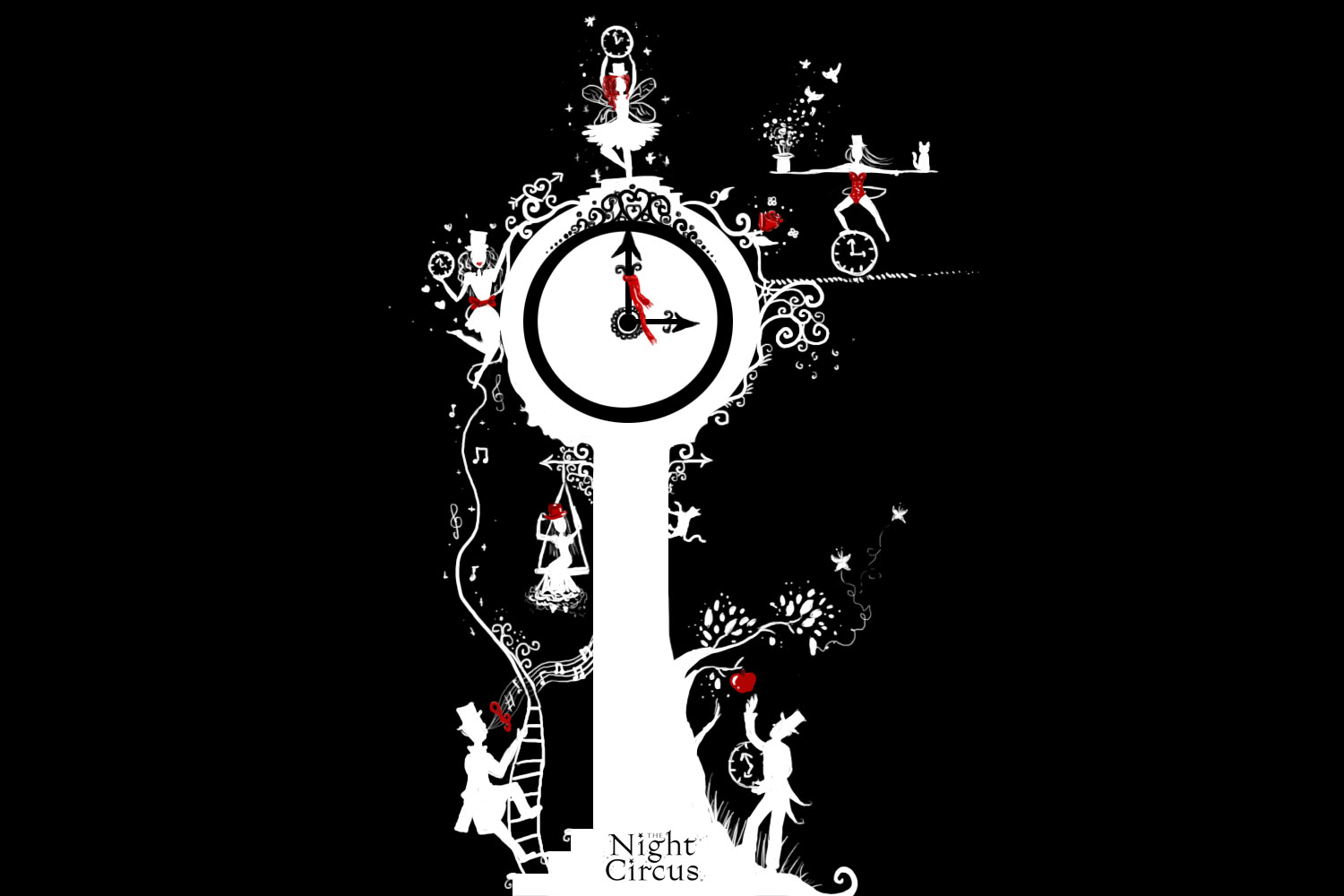
image courtesy of deviant art

"Dessert consists mainly of a gargantuan tiered cake shaped to resemble circus tents and frosted in stripes, the filling within a bright shock of raspberry cream. There are also miniature chocolate leopards, and strawberries coated in looping patterns of dark and white chocolates." - The Night Circus


The characters all speak in the same, dreamy way, so I could hardly tell one from the other. What was the difference between Celia and Isobel, anyway? One does magic and the other reads cards and they both are attracted to Marco (who also speaks like both of them.)

At last I reached the final section of the book, and finally the story took hold. In the ending 30%, I wanted to keep reading - no longer was it a matter of slogging on through bogs of caramel and popcorn. At last, the competition between Celia and Marco became real and important. Moreover, the characters Poppet and Bailey took center stage, and they were vivid enough to catch my imagination and care about what happened to them, very much. I could envision a sequel about those two, in fact. 
image courtesy of guardian.co.uk

The Night Circus left me in a quandary. On one hand I loved Morgenstern's language and prowess with words - if the chapters had been presented as interwoven short stories, I might have enjoyed the first major portion of the novel more. On the other hand, the writing was so misty that I couldn't stand much more than a few pages at a time - even a scene where a woman walks in front of a train is told in the manner of a Degas painting. 

I have been told that Jim Dale narrates the audio version, and I think that might be the way to go with the book. Dale's own magic would instil the characters with their own voices, adding layers to the floating beauty of Morgenstern's poetry. Perhaps he could add a bit of irony to the conversations as well, so a comment like this: "I thought it might be easier if you doubted him. And I gave you a year to find a way for the circus to continue without you. You have not. I am stepping in..." might become more realistic, as well as the dreamy response. (If only Celia reacted by saying, "You know what? Go to hell.")

So this review is a tale of two books: the long beginning that I struggled through and the ending that gripped my attention and wouldn't let go.

Friday, November 30, 2012

[sic] by Scott Kelly

I love the cover; it's simple and complex at the same time.
It's difficult to find a really well-written book that has a driving concept behind it. Some start with a great idea and others have beautiful prose, but to have both interwoven in one book is a rare, lovely thing. The Age of Miracles is one - the idea that the planet's revolution is gradually slowing sings out with lush phrases.

[sic] is another. The book is about a group of kids who play a game called Eureka, invented by David, the ringleader (more about him later.) In the game, if someone gets tagged "It," they must do something in the next fifteen minutes to completely change his life. Or her life. 

At first the game is simple - a damaged, gorgeous girl gets tagged and kisses a nerdy guy in front of everyone in the school, David switches paperwork between two McMansions. But as things progress, the game and the changes inflicted by the kids themselves become more and more trippy.

That's the concept, and it's a good one. A lesser writer would have created a decent manuscript that tells the story of the kids and the game as a compelling enough read. But this is Scott Kelly, who is a real wordsmith. Look at how he describes Kent's father, the landlord of the trailer park where the Eureka players all live:
Scott Kelly, the author

Kent's dad slept under an awning. Rolls of fat spilled out from the sides of the larn chair. Dad once warned me to stay away from Mr. Gimble - fairly easy advice to follow, because the landlord seemed violent and pissed off at all times.
A sweaty thatch of faded blondhair gave way to fat cheeks and thick jowls. What struck me most was how sad Kent's dad looked. Not mad at all. Just a defeated frown, like he was about to start bawling in his sleep. Like dreaming was torment. Like it hurt to be.
I could guess the cause of his nightmares: the landlord hated being alone with himself.

The narrator is Jacob. He frames the story as he speaks to police, to a youth psychologist, and also to us. [sic] begins with David's death, and throughout the book, Jacob is trying to describe what happened. I dare you to read that first paragraph and not want to find out what happens:

My personal savior is named David Bloom, and presently he's falling about ten stories from the top of a water tower. And my stupid stunned mind; all I can think is that he looks great doing it. Arms spread, fingertips extended, face serene - homicide by stage dive. His body returns to the earth below, the ten-story drop reducing him to a streak of white and blue cloth, brown hair blown back from closed eyes. Maybe he's smiling. Maybe I just like to think so.

By the way - the story is told in the past tense, a big plus for me. I'm not a present tense fan at all. After that first paragraph, the tense switches smoothly to the past, and Kelly makes it work. And the added concept of David's fall (or flight) is extended throughout the book, as Jacob seeks the blame for David's death: "I blame the death of David Bloom on the fact that after the math, David always won. His solar system spun, and we were trapped in its orbit."

David himself is the catalyst, although his influence extends through the other kids. He is attractive: 

David's skin shone against low-hanging sun, wisps of curled brown hair a halo charged by the dawn's light. Never got a haircut his mom didn't give, so it was shoulder-length, in calm curls. 
Angry almond eyes.

The other kids are vivid characters as well. There is Kent, the son of the landlord, who could have been a simple, static character but reveals layers of personality as the story unfolds. Cameron is the damaged beauty, molested by Kent's dad, who kisses Steven, the dweeby guy. There's Emily, the girl who is "all dyed black hair and army boots." She might be one of my favorite characters, even though she is dangerous - perhaps because she is dangerous - she refuses to put up with things as they are. Perhaps it is the reason that she embraces Eureka. The kids are the players : they are called the Six.

And then there is an outsider, Nora - an overweight girl that Jacob falls for. The description of her and the growing relationship between Jacob and the girl who refuses to play the game that takes over the lives of the Six. 

That creates a great tension between her and Jacob, although the other relationships (between Cameron and Kent, Emily and Jacob, and Jacob and David himself) are also explored deeply. 

It's as if Kelly stretches things, so we can see the thoughts and feelings behind the mumbled conversations and making out sessions between the members of the Six and Nora. He finds the "liminal spaces" (read the book to find out what that is) hiding in their interactions.

There were some sections that made me pause. For example, in the second half of the book, when David talks to the Six about his philosophy, he doesn't sound like a teen but a professor. I get that he is supremely intelligent (he paints impressions of music so you can almost hear it) but would a teen kid really say, "Change is the only constant, and so we must constantly change"?

I was also disappointed that Nora became a thin girl. Over the course of the book, she loses weight and shows off her mile-longlegs and her "athletic ponytail." I would have loved the originality if Jacob had continued to fall for her, pounds and all.

However, I must say that these flaws (along with one POV change and one over-compression of events) stood out BECAUSE the book is so good. If that lesser writer had offered the book, these would have been lost, as trash inside a messy trailer gets kicked to one side. In the glowing symphony of Kelly's book, I noticed them because of the beauty of everything else.

And let me mention here, before I forget, the soaring beauty of the grackle image - those birds that pick trash near the trailerpark. They occur throughout the book, and it is a lovely, sustained metaphor.

I would still highly recommend [sic] because of the concept, the writing, the characters - and the amazing ending. The book accomplished that rare thing - it entertained me and made me think, at the same time. 

You can purchase [sic] on Amazon or add it to your Goodreads list.

As well, read more about Scott Kelly's book on Facebook or his author website.