Showing posts with label Native Americans. Show all posts

Sunday, October 13, 2013

Indian 101 for Writers, Part 5: Walking In Two Worlds

Alison DeLuca, purveyor of Fresh Pot of Tea, and Kara Stewart, part-time post pusher at Kara Stewart Art in Photography, have collaborated to bring you this five part traveling blog series. 

This series takes a look at writing about Native Americans and gives resources to accurately and respectfully do so.  

Alison DeLuca is is the author of several YA steampunk books. She is committed to adding characters with different ethnic backgrounds to her works, and is always looking for authentic, realistic ways to do so. 

Kara Stewart is Native, an enrolled member of the Sappony, and white, and is a full-time Literacy Coach in the public schools, as well as serves in several Indian organizations, with a passion for photography, writing and Indian education. Her disclaimer for this series, “The views I express in this series are my personal views, brought about my own experiences and many years in literacy and education. I do not claim to represent the views of all Indians, but I do hope writers will find helpful resources and perspectives.”

Today we host the last in our five-part series,
Indian 101 for Writers, Part Five: Walking In Two Worlds.

Alison: Do you have quite a bit of interaction with people from your culture? What desires, if any, do they express for representation within literature and film?

Kara: Your first question is a difficult one to answer because I don’t/can’t really separate my culture from me; I am as much Indian as I am white. As much white as I am Indian. So I live in both worlds equally. Our mainstream culture in America is white; I don’t think anyone could sensibly argue that. So of course I live in that world. We all do, no matter if we are black, white, Latina, Native or Asian or multiracial.

Powwow by Kara Stewart
But as far as my Indian world, I am involved in Indian education in North Carolina and am fortunate to know a number of other North Carolina Indian people through that. I also currently serve an elected position as a tribal council member for my tribe, the Sappony, and tap into Indian issues that way. I am active in our tribe through volunteer activities such as our youth camp and other events, which give me regular contact with tribal members. And the main thing - tribal members are my family. So calling my cousin and talking to her would count as “interaction with people from my culture”, no? Going to a party with a friend who happens to be Native would count as “interaction with people from my culture”? I don’t know. It’s hard to separate and I'm not sure it's possible to. 

The Visitor by Kara Stewart

The concept of living in two worlds is very common for Indian people. For many (myself included), there’s a whole other world going on for us, parallel to the mainstream world. There’s a parallel, Indian stream of information, issues, events, and people that we navigate along with those things in the mainstream world. This parallel stream makes us aware of these things on multiple levels – how information, issues, events and people impact, are perceived and relate to the mainstream world, and how they impact, are perceived and relate to Indian Country. These two streams weave together, sometimes clashing (as when faced with stereotypes and possibly well-intentioned but uneducated statements). What you, as writers, teachers, humans, can do is to educate yourselves. Open your eyes to an entire world going on around you that you haven’t taken the time to notice before. And ask us. Talk with us. Don’t be afraid of race conversations or approaching us. We know we’re Indian, just like most black people know they are black and most Latinos know they are Latino! It's okay and it’s not a secret. Talk with us.

Powwow Barbies by Kara Stewart
As far as your second question, what Indians would like expressed about us in literature and film, what I have mostly heard from friends and family is the wish to be portrayed accurately, respectfully and to be real when you write about us. To be aware of, and not perpetuate, the stereotypes, or to even do a little stereotype-busting! We will read your books and be hurt by your stereotypes. Our children are hurt by teachers and authors who unknowingly promote stereotypes. Make it real. Because we are real.

Thank you, Alison, for the idea for this blog series, for working with me on it and for hosting our 'hops'! It has truly been a pleasure creating this series with you, my friend.


Indian 101 for Writers, Part 1: Know Thyself
Indian 101 for Writers, Part 2: Know Whereof You Speak (a.k.a. Don't Make It Up or Rely On What You *Think* You Know)
Indian 101 for Writers, Part 3: Keep It Real, People
Indian 101 for Writers, Part 4: Aargh!
Indian 101 for Writers, Part 5: Walking In Two Worlds

Jingle by Kara Stewart


Friday, October 11, 2013

Indian 101 for Writers Part 3: Keep It Real, People

Alison DeLuca, purveyor of Fresh Pot of Tea, and Kara Stewart, part-time post pusher at Kara Stewart Art in Photography, have collaborated on a new five part traveling blog series! This series will take a look at writing about Native Americans and giving resources to accurately and respectfully do so.  

Alison DeLuca is is the author of several YA steampunk books. She is committed to adding characters with different ethnic backgrounds to her works, and is always looking for authentic, realistic ways to do so. 

Kara Stewart is Native, an enrolled member of the Sappony, and white, and is a full-time Literacy Coach in the public schools, as well as serves in several Indian organizations, with a passion for art, writing and Indian education. Her disclaimer for this series, “The views I express in this series are my personal, brought about my own experiences and many years in literacy and education. I do not claim to represent the views of all Indians, but I do hope writers will find helpful resources and perspectives.”

Today we host Indian 101 for Writers, Part Three: Keep It Real, People.
See Part 1 and Part 2.

Alison: Which novels represent, in your opinion, Native culture in a fair and accurate way? Which novels would you recommend that writers read before they write Indian characters into their novels?

Kara: I love Sherman Alexie’s novels. He is Spokane/Coeur d’Alene and his writing exemplifies the Native sense of humor* about the world (which is the one thing I’d generalize as far as ‘India
ns’). His novel, The Absolutely True Diary of a Part-Time Indian is a must read for anyone thinking about writing about an Indian character – or just for a great, hilarious read. The movie, Smoke Signals, based on Alexie’s novel, The Lone Ranger and Tonto Fistfight In Heaven, has become an Indian Country iconic cult film, and will also give writers insight. Also definitely worthy of mention is his novel Reservation Blues, and the soundtrack of Reservation Blues, which  is one of my soul touchers with the tracks deeply embedding parts of certain tribes’culture and overarching themes common to many tribes.  Another film of his particularly germane to writers is The Business of Fancydancing (scroll down), which speaks to identity. One thing to keep in mind is that Alexie portrays what he knows (or knew at the time) – reservation life. It is important to realize that the majority of Indians in America do not live on reservations (22% as of 2010).


Those novels, and the films, have Indian Country front and center, but his characters are people first, who just happen to be Indian. I think that is the key: their ‘Indianness’ doesn’t define them. For a read on how Alexie incorporates an Indian character seamlessly, accurately and respectfully into a crime novel, read his novel Indian Killer. It’s just as important to incorporate one Indian character well (not coming across as a token Indian without any reason for being in the novel other than an attempt at diversity – although an attempt at diversity is better than no attempt at diversity).

What I appreciate most about Alexie’s novels is that he keeps it real. His characters have humor as well as in-depth emotion, they are current, they care about issues, they have grandmothers and fathers they feel ambivalent about, like many people - they are real people who happen to be Indian. They are not whooping warriors, New Age mystics or (my personal peeve) the “noble Indian” who reveres or worships nature and whose every action is some sort of ritual. That makes me want to scrrrreeeaaaammmm! Just get real. We (Indians) are no more noble than white people, black people or any other people. If there is some sort of accurate, legitimate, researched ritual you feel is integral to your story, okay, have the character just do it and then go eat their fry bread and turn up the radio!

I’d also recommend that authors read Louise Erdrich’s books The Birchbark House,  The Game of Silence and The Porcupine Year for examples of writing realistically and respectfully about Natives in a historic setting. Her characters are also touching, real, and while they are Indian, that is not the reason they are in the story – they are people first. I read part of The Birchbark House sitting in a faculty meeting and cried for a good portion of that meeting while I read! Couldn’t put it down. Okay, and yes, I missed the info I was supposed to be paying attention to in the meeting. But hey, bibliophiles can relate.

DebbieReese’s great blog, American Indians in Children’s Literature, has Indian point of view reviews of books involving Indian characters. I’d recommend checking it out to see some examples of issues with writing Indian characters. 

*For other examples of Indian humor and an inside peek at our 'real', see Powwow Comedy Jam, Charlie Hill on the Comedy Network, 7 Ways to Tell if a Native Girl Likes You, Ernie Tsosie III, Tatanka Means and my favorites, 1491s. and here and here or just google 1491s. Slapping Medicine Man cracks me up every time. Why? I don't know. But it does.

Take away: Find out about real Indians - Indians who are alive today and working in all professions, who live in all cities and around the world, who laugh with their kids, get mad at their uncles, love their family traditions, hate their family traditions, read themselves to sleep, run out of gas, screw up at work, excel at work, try to make the world a better place, and are generally people.

Stay tuned for Indian 101 for Writers, Part Four: Aargh! tomorrow on Kara Stewart Art in Photography. 
Dagger Blanket Piece by Kara Stewart


Monday, January 7, 2013

How I Got it All Wrong or, Pocahontas

Last night my kid watched the movie Pocahontas, the Disney version. She came across it by accident, on Netflix, as I surely would have never chosen that film to show her.
Yup, gorgeous. But real? I don't think so.

Why not?

Well, let's start with the serious disregard of history, plus the demeaning of a princess's act of kindness and courage turned into a ploy to save her boyfriend. Plus - a one-shoulder dress that just happens to showcase the girl's body .... mutter.... Lovely though she is, and I do think that Pocahontas is one of the prettiest Disney Princesses ever, the movie was on my Do Not Watch Ever list.

But!!!
The real Pocahontas, in England. OK, girlfriend was still gorgeous.

My kid loved it. LOVED it.

I mean, she kept stopping the film to research what really happened, plus she couldn't wait to find out the end. I've tried to get her interested in the Disney Princesses, to no avail, and it just figures that the one I never showed her captured her interest.

So, Mom is being all PC, and kid is simply enjoying a movie.

There are some things I can take away from this:

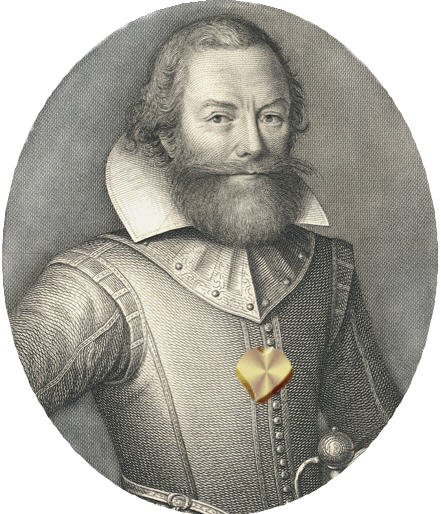
1. Kids love history and facts. Once I told my daughter, "Parts of this actually happened" she was enthralled. While I was all excited about Tangled, she was more interested in finding out about Captain John Smith (who did not look like that in real life, FYI, kid.)

2. Kids are going to love what they love, and parents simply can't stop that. Sure, I can provide guidance along the way, but at the end of the day Miss Thing is her own person.

3. My daughter was critical of the music in the movie. "Look, mommy - now even the willow is singing." Not every movie has to be eventually turned into a stage musical, Disney.
What Captain John Smith really looked like. That's very different, now, isn't it.

4. MUST POCAHONTAS HAVE A PERFECT MODEL'S MOUTH AS WELL AS LONG LEGS AND HAIR DOWN TO HER BUTT? REALLY? REALLY? AND HE HAS A CLEFT CHIN AND BLUE EYES.... argh - Obviously, I still have issues with this movie. Does that mean I forbid my daughter's watching it? In the end, I have to say No. Hopefully, I can provide some real historical content soon.

5. *SPOILER ALERT* The ending is really, really sad. No, I'm not talking about the movie - I'm talking about what happened for centuries afterwards. That's the main reason why I didn't want to watch Pocahontas - it makes me too depressed.

Still - back to the main point - my kid really, really loved it. And that, I suppose, is all.